
Written by
Michael McCabe
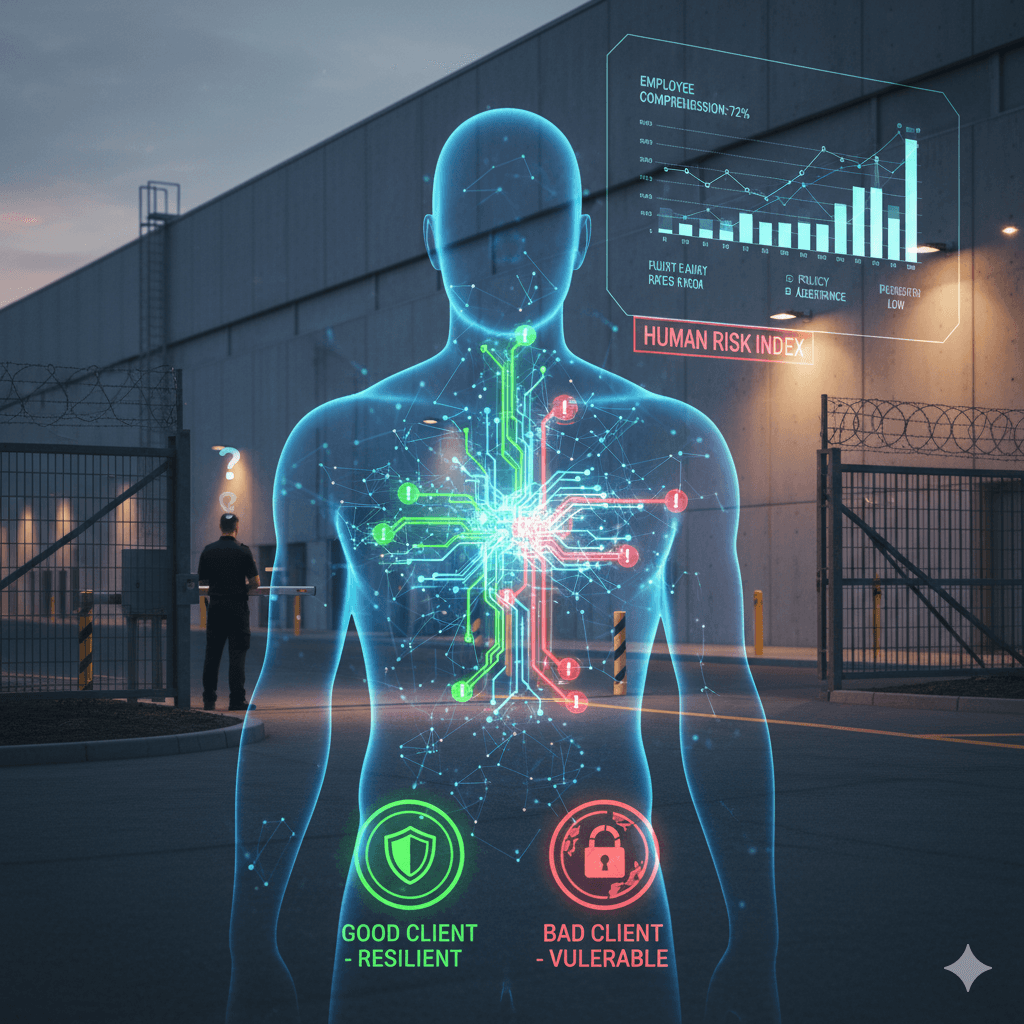
The Human Element: The New Underwriting Metric for Physical Security and P&C Insurance
For Property & Casualty (P&C) and Industrial Insurers, the next frontier in risk assessment isn't a new piece of hardware—it's the human element. While conventional Loss Control relies on inspecting fire suppression systems, access controls, and maintenance logs, the data proves this approach is incomplete.
Security reports consistently show that a staggering 60% to 95% of all security breaches, encompassing both cyber and physical vectors, involve human action. The biggest flaw in any security system isn't the technology; it's the people who operate, govern, and maintain it.
This intelligence transforms underwriting for large industrial, energy, and commercial assets by providing contextual data that traditional on-site surveys cannot capture. It moves the assessment beyond what controls are in place to how well the staff understands and executes those controls across key areas like governance, risk management, and maintenance.
Assessing Risk: Differentiating the Good Client from the Bad
This deep behavioral data enables P&C underwriters and loss control teams to differentiate between clients who merely have policies on paper and those with a robust, living security culture.
Risk Profile | The High-Risk Client (Bad Bet) | The Lower-Risk Client (Good Bet) |
Governance & Policy | Leadership oversight is broken, resulting in a lack of uniform accountability and inconsistent policy application. | Decision-making ownership is clear, with a strong link between board-level governance and consistent operational policies. |
Operational Procedures | Operations show inconsistent performance standards across different areas. Critical vulnerabilities are present in key physical systems (like access control and surveillance) due to design limitations or outdated systems. | The client actively monitors operational risk (a component of underwriting risk) and ensures a consistent application of protocols like maintenance and equipment checks. |
Risk Mitigation & Audit | Risk assessments are conducted, but the results are not integrated into plans or decision-making, showing a gap between awareness and execution. Audit value is lost because findings have no follow-through. | The organization is transparent about its weaknesses and actively uses the data to bridge the gap between understanding threats and acting on them. They are using performance data to create a continuous improvement roadmap for resilience. |
Conclusion
For industrial insurers, the ability to analyze a client’s internal comprehension of safety and security protocols is the ultimate risk signal. This behavioral data provides predictive insights into why a maintenance log might be fudged or why a gate is left unsecured—issues that are root causes of major property losses but are impossible to detect with conventional inspections.
By inspecting the human firewall, insurers can pinpoint precisely where awareness ends and failure begins, allowing them to more accurately price coverage and reward clients who demonstrate genuine, company-wide risk ownership and resilience.